
TEAM:
Joaquim Carneiro: Principal Investigator
Elisabete Freitas: Co-Principal Investigator
Hugo Silva: Researcher
Joel Oliveira: Researcher
Manuel Costa: Researcher
Paulo Pereira: Researcher
Vasco Teixeira: Researcher
Vuye Cedric: Researcher
NanoAir – Nanomaterials Applied on Innovative Road Pavements for Air-Cleaning
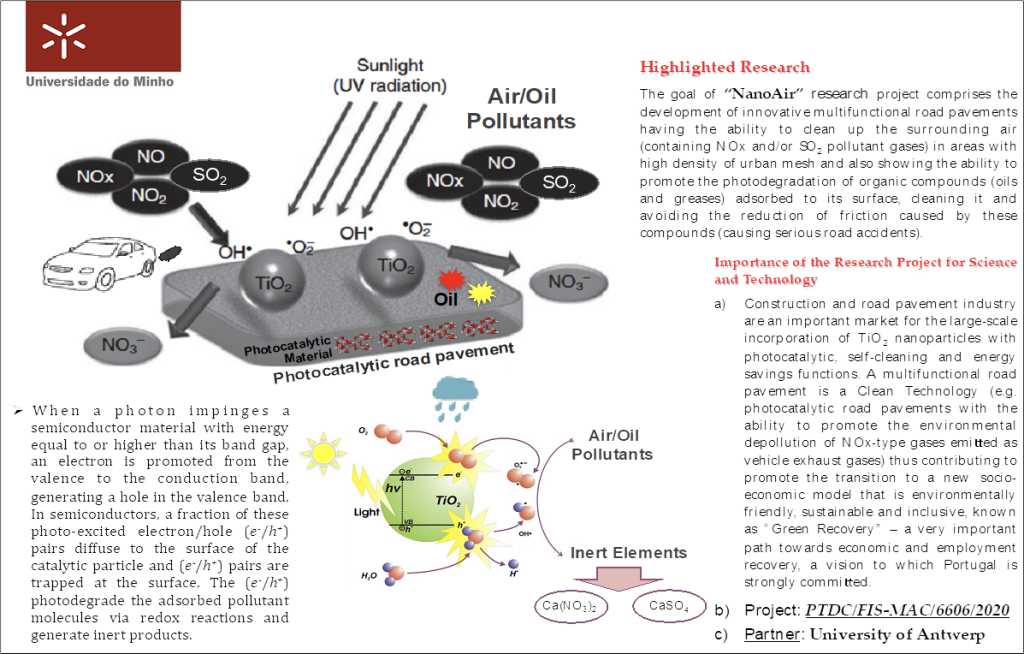
Photocatalytic asphalt pavements can clean the air and reduce road accidents through the photodegradation of pollutants. the main objective of this project is to evaluate the efficiency and durability of photocatalytic asphalt pavements and to assess the global impacts of the photocatalytic process in environmental, social and economic terms. This includes the implementation of doped TiO2 nanoparticles over asphalt mixtures, the study of their immobilization and the assessment of the global impacts.
Currently, heterogeneous semiconductor-mediated photocatalysis attracts significant interest due to its ability to efficiently convert ultraviolet (UV) light from solar radiation into chemical energy that can photodegrade harmful air pollutants. Due to the huge surface area of photocatalytic asphalt pavements and their proximity to car exhaust gases, they are cited as promising surfaces, with growing interest in the literature, for reducing the concentration of atmospheric pollutants SO2 and NOx. In addition, some semiconductors act as catalysts, when exposed to the action of UV radiation, promoting the photodecomposition of organic molecules adsorbed to the surface, such as oils and greases, cleaning it and mitigating the reduction of friction caused by these compounds, reducing the number of road accidents.
Industrial activities and road traffic are the main sources of pollutant emissions, mostly SO2 and NOx, which are very dangerous atmospheric pollutants according to the World Health Organization (WHO). Some consequences at different scales are due to these harmful gases: intensification of the greenhouse effect, acid rain and public health problems. According to WHO, more than 90% of the world population lives in places where the concentrations of pollutants exceed their limits. WHO estimates that 4.2 million people die every year only due to air pollution. In developed countries, low emission zones limit the circulation of transport that mainly requires diesel in urban centers. The United Nations (UN), for example, discusses the issue of environmental pollution since 1972 at the Stockholm Conference, Sweden, and more recently at COP 25 in Madrid, Spain. Currently, according to WHO, the world population suffers the pandemic outbreak caused by Covid-19, resulting in respiratory diseases. Recent investigations show that the main victims are elderly people and/or people with respiratory problems presented before the contamination. The indispensable urgency for the reduction of air pollutants is clear from different scales and needs.